
Can I Drink Alcohol When Trying To Conceive ?
The Million Dollar Question
Does Alcohol Affect Your Fertility ?
If you’re on a fertility journey, you’ve probably asked yourself: ‘Does that glass of wine really matter?’ Or maybe you’ve wondered if mixing drinks could be affecting your chances of conceiving.
As someone who’s walked this path with so many women, I know how confusing it can be to separate fact from myth, especially when it comes to alcohol. So let’s talk about it: How does alcohol impact fertility for both you and your partner?
What do the experts actually recommend when you’re trying to get pregnant or already expecting?
And, most importantly, how could it affect your baby? Because when it comes to your health and your future little one, clarity is everything.
How Does Alcohol Impact Female Fertility ?
If you’ve ever wondered how that glass of wine might be affecting your fertility, you’re not alone. Alcohol can throw off your hormones by boosting estrogen while lowering progesterone, leading to irregular cycles or even stopping ovulation altogether.
That imbalance makes it harder for your ovaries to release an egg, and over time, heavy drinking can even reduce your egg supply, as we see with lower AMH levels. But it’s not just about the numbers; chronic alcohol use can also damage ovarian tissue and disrupt the delicate dance between your brain and ovaries, sometimes even contributing to conditions like PCOS or weight gain, both of which can make conceiving more difficult. It’s a lot to take in, but understanding this helps you make choices that truly support your body and your journey. (How Alcohol Affects Male and Female Fertility).
And what about Mixing your Drinks ?
Some research suggests that the type of alcohol consumed may influence fertility outcomes; for instance, wine consumption has been associated with shorter time to pregnancy in some studies, while hard alcholic drinks may have more pronounced negative effects. Overall, the quantity and frequency of alcohol consumption appears more critical than the specific mix of beverage types. (Female alcohol consumption and fecundability: a systematic review and dose-response meta-analysis | Scientific Reports)
And How About Our Male Counterparts ?

And it’s not just us ladies that suffer from the affects of alcohol, your partner does too.
Research shows that for men, even regular drinking can lower sperm quality, count, and movement, making it harder for sperm to reach and fertilize an egg.
Heavy drinking can shrink semen volume, reduce testosterone, and even throw off the hormones that signal sperm production. The good news? The body is resilient. Cutting back or quitting can improve sperm health within just a few months, giving you both a better chance to conceive. (Impact of Alcohol Consumption on Male Fertility Potential: A Narrative Review - PMC)
So What's the Official Advice ?
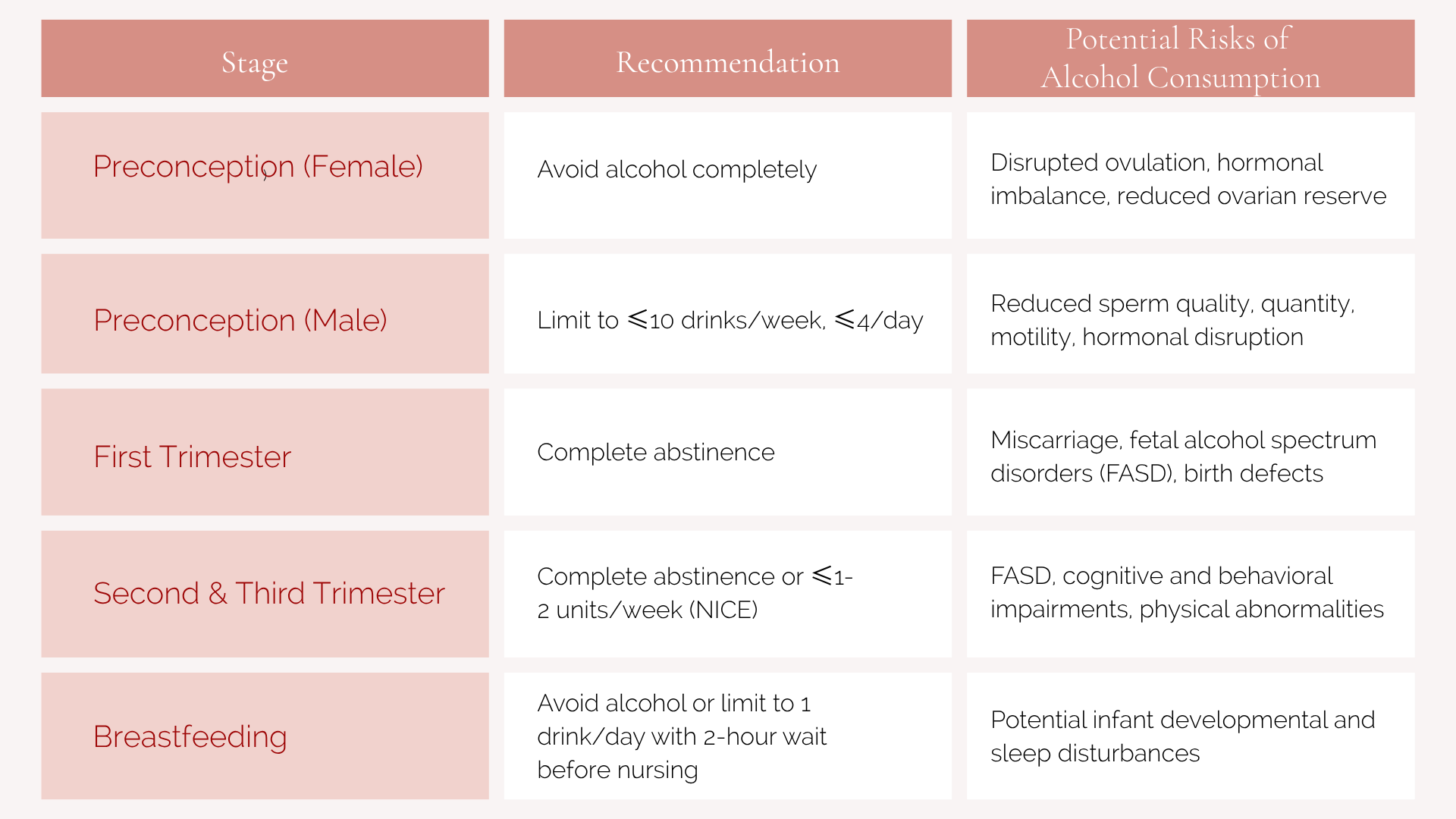
I know how overwhelming it can feel to navigate all the ‘shoulds’ and ‘should nots’ when you’re trying to conceive or are already pregnant. Experts such as the CDC, ACOG, and WHO are very clear: the safest choice is to avoid alcohol completely when you’re trying for a baby. Why? Because even a little can disrupt ovulation, throw your hormones off balance, and lower your chances of success, especially if you’re doing IVF. And for men, regular drinking can affect sperm health too.
Now, if you’re already pregnant, the message is the same: no amount of alcohol is considered safe. The first few weeks are especially critical, as your baby’s tiny organs and brain are forming. Alcohol can interfere with this delicate process, leading to lifelong challenges like learning difficulties, behavioural issues, or even physical differences such as Fetal Alcohol Spectrum Disorders (FASD). Funnily enough, I actually came across FASD when we were going through the adoption process as something to look out for. And the risks don’t stop there. Children exposed to alcohol in the womb are more likely to face mental health struggles, developmental delays, and even trouble in school or later in life. So, it's not worth the risk.
I know it might feel like a lot to give up, but think of it this way: every choice you make now is a gift to your future child. And the good news? Your body is amazing. If you’ve been drinking and decide to stop, your fertility, and your baby’s health can start to improve right away. It’s never too late to make a change that supports your journey.
Alcohol Consumption Guidelines and Risks by Stage
CONCLUSION
So, what’s the takeaway? Alcohol has clear, well-documented effects on fertility for both men and women. For us, it can disrupt ovulation and throw our hormones out of balance, while for our partners, it can reduce sperm quality and quantity. And no, mixing different drinks doesn’t seem to add any extra risks beyond what alcohol itself already does.
The official word from health experts is simple: avoid alcohol when you’re trying to conceive and throughout pregnancy. Why? Because even small amounts can lead to fetal alcohol spectrum disorders and other serious risks for your baby, like physical, cognitive, and behavioral challenges that can last a lifetime.
If you’re planning a pregnancy, abstaining from alcohol is one of the best ways to support your fertility and give your future child the healthiest start possible. This isn’t about fear, it’s about empowerment. It's about knowing the facts so you can make the choices that feel right for you, your journey and your baby.
References:
📌And one last thing....Are you Ready to Connect, Share, and Bloom Together ?
If this blog post resonated with you, I’d love for you to join 🐝The Hive. It's absolutely FREEand a placewhere we can chat about all things Women's Health and Wellbeing. This is a space where we come together to explore all things womb and women's wellness: fertility, pregnancy, menopause and beyond. Here, you’ll find support, wisdom, and a sisterhood of women who truly understand your journey.
👉Join 🐝The Hive, and let's thrive
With love and moonlit blessings,
Catherine 🌹

Disclaimer:
The information shared here is intended solely for educational and informational purposes. It is not medical advice, diagnosis, or treatment of any kind. I am a Reflexologist specialising in Fertility and Pregnancy, Soulful Doula, EFT Practitioner, Yoga Teacher, Womb Shaman, Fertile Body Method Practitioner, and Women’s Health Coach. All guidance provided here is offered to support your personal empowerment and self-awareness.
You are encouraged to tune into your own body wisdom. Your body and womb space always know what is best for you. However, if you are experiencing specific health concerns or conditions, please seek the advice and care of a qualified medical or healthcare practitioner.
Always trust yourself and follow what feels right and true for you.


